In 2026, commercial displays must do more than attract attention. They must survive transport, installation, cleaning, and daily public contact. That pressure explains the growing interest in composite materials. A retail wall may face fingerprints, trolley impacts, bright lighting, and frequent graphic changes. Why use composite materials for commercial displays? The answer begins with balance: low weight, surface stability, design freedom, and dependable performance. Yet no material solves every problem. That matters.
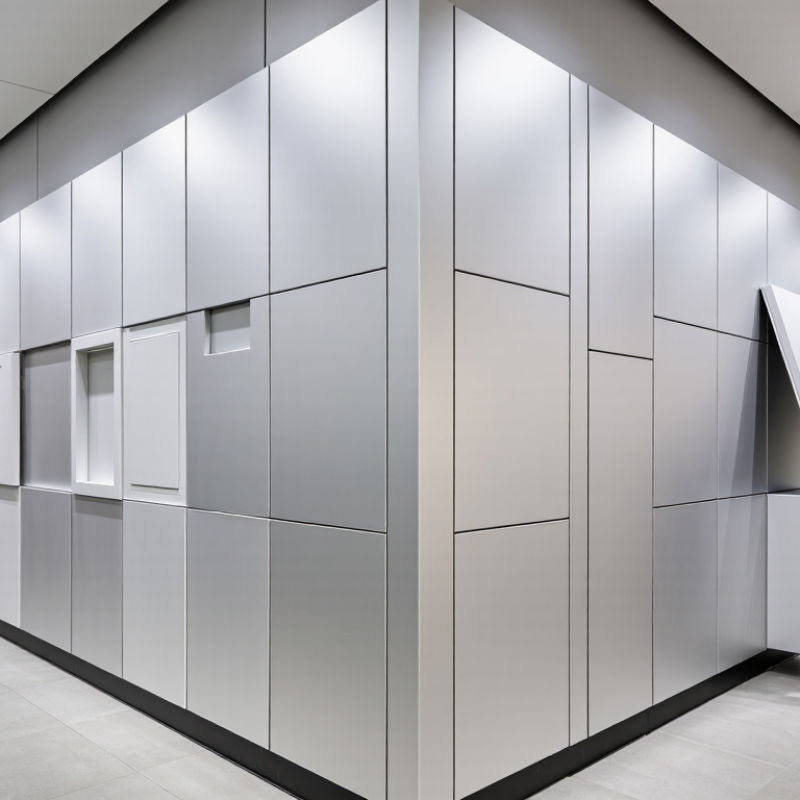
Composite panels can combine a lightweight core with aluminum skins, mineral content, or reinforced polymers. This structure may create broad, flat surfaces without the mass of solid metal or thick timber. Installers often value easier handling, cleaner edges, and repeatable modular construction. Designers can specify matte textures, printed finishes, routed letters, or concealed fixing systems. In busy shops and exhibition halls, these details reduce visual clutter. However, performance depends on formulation, thickness, joints, and workmanship. A beautiful sample can mislead. Test it under real conditions.
Responsible 2026 specification should examine fire behavior, impact resistance, moisture exposure, indoor air quality, maintenance, and end-of-life options. Project teams should request technical data, installation guidance, warranty limits, and evidence for recycled or recyclable content. Local building, accessibility, and environmental requirements still govern the final choice. Independent testing and qualified installers add confidence, especially for suspended or high-traffic displays. Composite materials can lower handling effort and expand creative possibilities, but sustainability claims need careful verification. Some products remain difficult to separate or recycle. That is an uncomfortable detail. This introduction explores where composites genuinely improve commercial displays, where risks remain, and how evidence should guide purchasing decisions in 2026.
The digital signage market is projected to reach $51.68 billion by 2030, according to Grand View Research. This growth reflects a clear shift toward larger, brighter, and more interactive commercial displays. Retail stores, transport hubs, hotels, and exhibition spaces now demand structures that look refined while surviving constant public contact. Composite materials can meet that balance. They combine low weight, structural strength, and design flexibility in one panel or enclosure.
Installation teams often notice the difference first. A lighter display frame can reduce handling time, simplify wall mounting, and lower transport demands. Composite panels also support clean curves, thin edges, and concealed cable routes. These details matter when a screen is viewed from only a few meters away. Many composites resist moisture, corrosion, and everyday surface wear, supporting longer service in busy interiors and sheltered outdoor areas. Still, performance depends on the core, resin, finish, and connection method. Material choice cannot be treated as a shortcut.
There is a catch. Some composite products are difficult to repair or recycle, especially when layers are permanently bonded. Designers should request verified test data for fire behavior, impact resistance, weather exposure, and dimensional stability. A display may look perfect on opening day. That is not enough. Long-term maintenance, replacement access, and end-of-life handling should shape the specification from the beginning. In a market expanding toward $51.68 billion, practical reliability may matter more than a dramatic first impression.
Commercial displays in 2026 need to look light while surviving transport, vibration, and repeated installation. Carbon fiber reinforced polymer (CFRP) helps solve that tension. Its strength-to-weight ratio can reach about five times that of steel, according to comparative materials data referenced by ASM. The figure describes specific strength, not total strength in every application.
On a retail prototype, a CFRP support can reduce frame weight without making the display feel fragile. A lighter panel is easier to lift above a crowded aisle. It also reduces the load on hinges, brackets, and ceiling attachments. However, CFRP behaves differently from steel. Its strength depends on fiber direction, resin quality, thickness, and joint design. A thin edge can fail when drilled carelessly. That detail is often missed.
Tips: Specify fiber orientation early. Test fasteners separately. Leave room for inspection.
Engineers should review impact resistance, fire performance, ultraviolet exposure, and repair methods before approving a commercial display. CFRP does not automatically outperform steel in every condition. A steel bracket may remain more practical near sharp corners or high-contact zones. I have seen weight savings disappear when designers add oversized connectors and protective covers. The material was efficient, but the assembly was not. Honest evaluation needs prototypes, documented load cases, and testing under realistic handling conditions.
Composite panels are changing how commercial displays are designed. In practical mock-ups, lightweight sandwich construction can reduce panel weight by up to 60% compared with solid metal sheets. The saving comes from a thin, strong skin around a low-density core. It is not magic.
The saving comes from a thin, strong skin around a low-density core.
A lighter display needs fewer people during installation. It also places less stress on hinges, brackets, and temporary flooring.
The U.S. Department of Energy’s 2023 Lightweight Materials report links a 10% mass reduction with approximately 6–8% lower energy use in vehicle applications. Displays are different, but the transport principle remains relevant. Lower mass can mean easier handling and fewer delivery risks.
The 60% figure is useful, but imperfect. Results depend on panel thickness, core density, frame design, and hardware. A 2024 European Commission Joint Research Centre review on circular materials also warns that resin selection and end-of-life processing affect environmental performance. Designers should request verified weight data, fire-test records, moisture resistance results, and load calculations. ASTM and ISO testing can support those checks.
The trade-off is real. Some composites are difficult to repair or separate after use. A cheaper, lighter panel may create waste later. Good design considers both installation day and removal day. That is where professional judgment matters.
Why Use Composite Materials for Commercial Displays in 2026?
Commercial displays often travel between factories, warehouses, venues, and storage sites. That hidden journey adds fuel use and emissions before installation begins. Composite materials can reduce this burden through lower structural weight. A lighter frame needs less energy during loading, handling, and transportation. Small savings repeat across many events.
For example, removing 30 kilograms from one display can change pallet planning and vehicle capacity. More units may fit on a shipment. Fewer handling devices may be required. These effects should be measured, not assumed. A credible lifecycle review tracks material weight, transport distance, packaging, installation, repairs, and end-of-life treatment. Material quantity matters. Recycled content can help, but it does not erase manufacturing impacts.
The calculation is not always flattering. Some composite panels require energy-intensive production or difficult separation after use. A durable display may still lose value if damaged components cannot be repaired. Designers should use replaceable skins, accessible fasteners, and clearly documented material layers. In practical projects, these details influence service life more than appearance alone. Transport records and maintenance notes can reveal whether the expected savings actually happened. That evidence supports better decisions in 2026.
Why Use Composite Materials for Commercial Displays in 2026?
Material Selection: Compare FRP, ACM, and Aluminum Using LCA Metrics
Commercial display materials should be judged beyond purchase price. Life-cycle assessment, or LCA, tracks emissions from extraction through disposal. The result can challenge common assumptions.
FRP offers low weight, corrosion resistance, and long service in damp locations. Its glass fibers and resin, however, can complicate recycling. ACM uses thin aluminum skins around a polymer core. It is light and rigid, but separating those layers requires specialized processing. Aluminum usually carries high production emissions when made from primary ore. Recycled content can change that result dramatically.
In our project reviews, transport often altered the ranking. A lightweight panel shipped across continents was not always the lowest-impact option. We now record mass, recycled content, manufacturing energy, expected service life, cleaning needs, and replacement rates. We also request product-specific environmental data, preferably verified against ISO 14040 and ISO 14044 principles.
Small details matter. A scratched display may need a full replacement, not simple repair. FRP may last longer outdoors, though its end-of-life pathway remains uncertain. ACM can reduce structural weight, yet mixed-material recovery is easy to overlook. Aluminum’s recycling value is strong, but collection is not guaranteed. Our first comparison was too neat. Site conditions, local recycling access, and real maintenance records deserve more weight. Lifespan estimates still contain uncertainty.
| LCA and Design Dimension | FRP Glass-Fiber-Reinforced Polymer |
ACM Aluminum Composite Material |
Aluminum Sheet | Selection Implication for Commercial Displays |
|---|---|---|---|---|
| Typical construction | Glass fibers embedded in a thermoset or thermoplastic polymer matrix. | Two thin aluminum skins bonded to a polymer or mineral-filled core. | Rolled aluminum alloy sheet, commonly supplied with a protective or decorative finish. | Composite structures can achieve a useful balance of rigidity, weight, and surface finish. |
| Typical density | 1.5–2.0 g/cm³ | 1.4–1.8 g/cm³, depending on panel thickness and core formulation | Approximately 2.7 g/cm³ | FRP and ACM are generally lighter than a solid aluminum panel of comparable area. |
| Indicative cradle-to-gate embodied carbon | Approx. 4–9 kg CO₂e/kg | Approx. 4–10 kg CO₂e/kg | Approx. 8–16 kg CO₂e/kg for primary aluminum Approx. 0.5–2.5 kg CO₂e/kg with high recycled content |
Aluminum results are highly sensitive to recycled content and electricity mix; supplier-specific EPDs should be used for procurement decisions. |
| Indicative manufacturing energy | Approx. 50–120 MJ/kg | Approx. 60–150 MJ/kg | Approx. 150–250 MJ/kg for primary production Approx. 10–30 MJ/kg for secondary production |
Recycled aluminum can substantially reduce production energy, although forming, coating, and transport remain relevant. |
| Recycled content potential | Usually low to moderate; depends on resin system and availability of recycled fibers or polymers. | Moderate to high for aluminum skins; polymer-core recycled content varies by construction and specification. | High potential; aluminum can be repeatedly recycled without loss of its basic material properties. | Specify recycled content separately for each constituent rather than treating a composite panel as fully recyclable. |
| End-of-life recyclability | Limited for thermoset FRP because fibers and resin are difficult to separate; mechanical recycling is possible but downcycling is common. | Moderate to limited because aluminum skins and polymer cores require separation; mineral-filled cores may improve fire performance but complicate recovery. | High where clean collection and established metal-recycling routes are available. | Design for disassembly, avoid unnecessary permanent bonding, and identify material layers on drawings and labels. |
| Strength-to-weight performance | High; continuous fibers can provide strong, lightweight molded or pultruded sections. | High for flat panels; the bonded skins provide bending stiffness at low panel mass. | Moderate to high; strength and stiffness are reliable but mass increases with thickness. | FRP is advantageous for shaped structures; ACM is efficient for large flat faces; aluminum is dependable for formed or load-bearing details. |
| Corrosion and moisture resistance | Very good; does not rust, although resin, gel coat, fasteners, and joints still require protection. | Very good; exposed cut edges, fasteners, and incompatible metals require detailing. | Good; oxide protection is inherent, but coastal, alkaline, and galvanic environments require suitable alloy and finish selection. | For outdoor displays, joint design and coating maintenance can influence service life more than the panel material alone. |
| Expected display service life | Approximately 10–25 years with suitable UV protection and maintenance. | Approximately 10–20 years, depending on coating, core, edge detailing, and exposure. | Approximately 15–30+ years, depending on alloy, coating, environment, and maintenance. | Service-life assumptions should be verified against the project climate, cleaning regime, UV exposure, and warranty requirements. |
| Fire-performance considerations | Varies widely by resin and additive package; some systems produce smoke and require testing. | Varies by core: polymer cores and mineral-filled cores have materially different fire behavior. | Non-combustible metal, although coatings, adhesives, backing boards, and insulation can affect the completed assembly. | Evaluate the complete display assembly against the applicable building and fire code, not the face material alone. |
| Fabrication and finishing | Molding, pultrusion, routing, drilling, and gel-coat or paint finishing; dust control is required during cutting. | Routing, folding, drilling, bonding, and digital or liquid coating are common; avoid damaging the skins. | Cutting, bending, machining, welding, anodizing, painting, and powder coating are widely available. | Choose the process that minimizes scrap, rework, solvent use, and replacement during the display’s life. |
| Relative transport impact | Low to moderate because of low mass and efficient nesting potential. | Low to moderate because of low panel mass and flat-pack logistics. | Moderate to high for equivalent-area solid panels because of higher mass. | Transport savings are most meaningful when panels are shipped long distances or installed in large quantities. |
| Best-fit display applications | Curved forms, molded housings, lightweight frames, outdoor structures, and applications requiring electrical insulation. | Large flat sign faces, retail wall panels, modular graphics, cladding-style displays, and lightweight enclosures. | High-durability frames, formed details, thin precision components, reusable structures, and projects prioritizing recyclability. | For 2026 projects, select by whole-life performance rather than purchase price or material mass alone. |
| Recommended LCA data priority | Obtain resin type, fiber content, manufacturing process, recycled content, and end-of-life scenario. | Obtain skin thickness, core chemistry, recycled content, coating, bonding method, and separation route. | Obtain primary/secondary aluminum share, smelter electricity mix, rolling energy, coating, and recycling scenario. | Use product-specific, third-party-verified EPD data where available and compare identical functional units. |
Data note: Embodied-carbon and energy figures are indicative planning ranges for generic material production, not declarations for a specific product. Actual results vary with formulation, recycled content, electricity mix, manufacturing route, coating, transport, maintenance, and end-of-life assumptions. For a defensible project comparison, use ISO 14040/14044-aligned LCA data and product-specific EPDs under EN 15804 where available.
CFRP can provide about five times steel’s specific strength. This means more strength for less weight. A lighter panel is easier to lift above a crowded aisle. It also reduces loads on hinges and ceiling attachments.
No. Its performance depends on fiber direction, resin quality, thickness, and joint design. Steel may work better near sharp corners or high-contact areas. Not always.
Thin edges can fail when drilled carelessly. Test fasteners separately and inspect the drilled area. Specify fiber orientation early. Leave room for inspection.
Engineers should review impact resistance, fire performance, ultraviolet exposure, and repair methods. A display facing sunlight may need different protection from one used indoors.
Large connectors and protective covers can erase the frame’s weight savings. The material may be efficient, but the assembly is not. Prototype testing can reveal this problem.
Compare mass, recycled content, manufacturing energy, service life, cleaning needs, and replacement rates. Purchase price alone gives an incomplete picture. That matters.
No. Long-distance shipping can change the result. A light panel shipped across continents may create higher total impacts. Transport details deserve careful recording.
FRP contains glass fibers and resin, which can complicate recycling. ACM combines aluminum skins with a polymer core. Aluminum has strong recycling value, but collection is not guaranteed. Local facilities matter.
Not always. A scratch may require full replacement instead of simple repair. Designers should review maintenance records and replacement rates. Lifespan estimates remain uncertain.
As the digital signage market is projected to reach $51.68 billion by 2030, manufacturers are seeking display structures that combine durability, efficiency, and design flexibility. Why use composite materials for commercial displays? Composites can deliver high strength with significantly less weight than traditional metal solutions. Carbon fiber reinforced polymer, for example, offers up to five times the specific strength of steel, while composite panels may reduce display weight by as much as 60%. This enables slimmer designs, easier installation, and improved structural performance.
Their benefits also extend across the product lifecycle. Lightweight displays require less energy for transportation and can help reduce associated emissions, while resistance to corrosion may support longer service life and lower maintenance needs. For material selection, fiber-reinforced plastics, aluminum composite materials, and aluminum should be compared using lifecycle assessment metrics, including embodied energy, durability, recyclability, transportation impact, and end-of-life options. A balanced evaluation helps businesses choose the most practical and sustainable solution for commercial display applications in 2026.
